

The Dongguan test line is widely used in scenarios such as electronic manufacturing,equipment debugging,and instrument calibration.Different testing procedures have different requirements for conduction characteristics,electrical parameters,and interface compatibility.The construction of the Dongguan test line includes conductors,insulating layers,shielding layers,and end interfaces.Its core function is to achieve stable signal transmission.When users choose the test line,they usually pay attention to contact stability,conduction consistency,and wear resistance.The Dongguan test line is suitable for a variety of electrical performance testing procedures.
The Dongguan test line is suitable for resistance testing.This type of test relies on a stable conducting path.The thickness of the copper core of the test line determines the transient resistance value fluctuation.The thickness of the insulating layer determines the risk of leakage.The consistency of impedance can reduce the fluctuation of resistance readings.Users often use short-line test lines when verifying in the laboratory circuit.The short-line structure can reduce the impedance deviation caused by the line length.
The Dongguan test line is suitable for voltage measurement.Voltage testing requires stable interface contact.The interface ends of the test instrument are mostly in banana plug or vise clamp structure.If the end of the test line adopts a plated structure,it can reduce the impact of oxidation.The voltage signal has strong anti-interference ability.It has a low dependence on the shielding layer.It is suitable for on-site maintenance and equipment inspection.
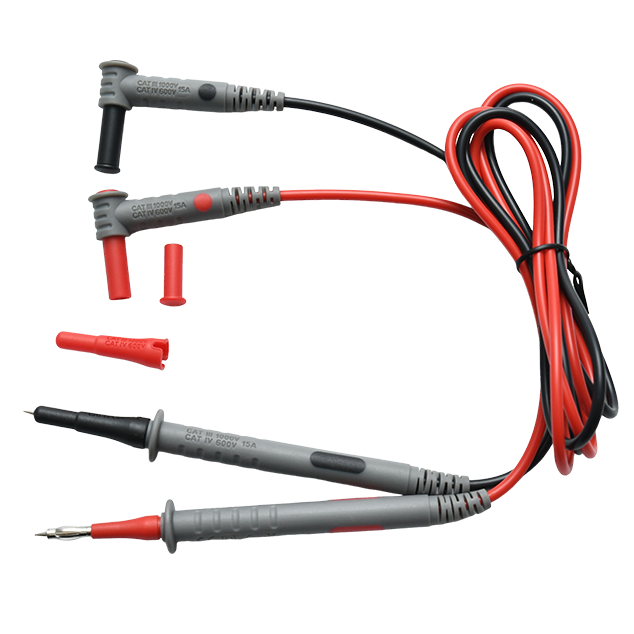
The Dongguan testing line is suitable for current testing.The current circuit has a high requirement for the carrying capacity of the conductor.When users choose the Dongguan testing line,they often pay attention to the square number of the conductor.The thickness of the conductor affects the degree of heat generation.The temperature resistance grade determines the long-term performance.Some processes are dynamic on-off.The flexibility of the testing line determines the convenience of operation.
The Dongguan test line is suitable for conduction tests.This test focuses on breakpoints,short circuits,and open circuits.If the contact pressure at the tip of the test line meets the process requirements,it can reduce false judgments.Fixture-type test lines mostly adopt a ribbon structure.They can maintain consistent contact pressure in multi-point tests.
The Dongguan test line is suitable for insulation resistance testing.The withstand voltage level of the insulating material determines the stability of the test.Users will use the test line with a smooth surface and no damage in a high-voltage environment.Damage points will create leakage paths.During the high-voltage process,attention should be paid to the outer diameter and material grade of the wire body.
The Dongguan test line is suitable for weak signal acquisition.Weak signals are significantly affected by environmental electromagnetic interference.A double-layer shielding structure can enhance stability.The higher the coverage rate of the shielding layer,the more stable the signal.This is commonly seen in sensor calibration,small current sampling,and high-precision instrument debugging.
The Dongguan test line is suitable for frequency response measurement.For high-frequency testing,attention is paid to impedance matching.The roundness of the line body,the conductor structure,and the shielding density determine the high-frequency stability.The shorter the test line length,the smaller the distortion.It is commonly used in communication equipment testing and RF module debugging.
In conclusion,the Dongguan test line is applicable to various types of testing processes such as resistance,voltage,current,conduction,insulation resistance,weak signals,and high frequency.Users can select the appropriate structure based on the characteristics of the process to enhance stability.

Address: Room 503, Building 3, No. 36, Longyan Industrial Road, Humen Town, Dongguan City, Guangdong Province
Number: 135-0984-750
Email: dgiaz168@163.com